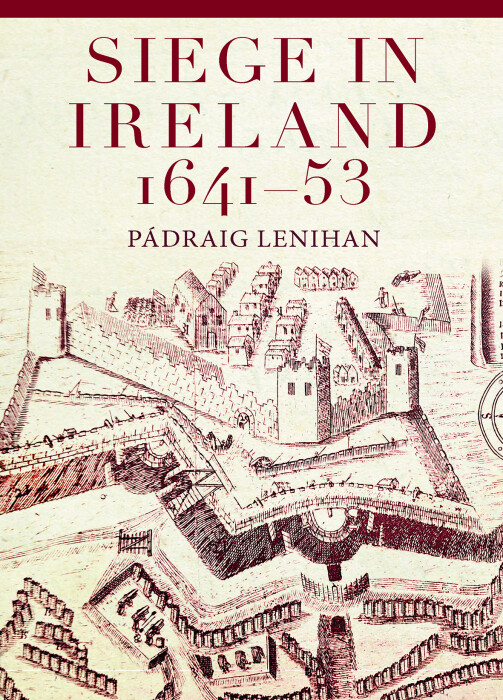
Siege in Ireland 1641-53
Blood and Stone
Pádraig Lenihan
“Siege, not pitched battle, was the predominant military tactic used by all sides during the Irish Confederate Wars, the conflict that devastated Ireland between 1641 and 1653. [...] Indeed, some of the key events and figures encountered in this outstanding new book from Pádraig Lenihan are seared in Ireland’s collective historical and cultural memory. [...] It is important to note that atrocities were committed by every side in this bitter conflict. Therefore, it is testament to Lenihan’s professionalism as a historian that he does not shrink from discussing this uncomfortable truth. A retired university history lecturer, former Irish army artillery captain and highly respected scholar with an intimate knowledge of early modern Irish society, culture, warfare and fortifications, Lenihan is well placed to tell this story. He aims to put the reader at the centre of the siege experiences by using first-hand accounts of the people involved. A gripping and, at times, unnerving read, Lenihan’s forensic approach to historical detail, military logistics and everyday practicalities shows that, if anything, the reality of Irish siege warfare was even more brutal than we could possibly have ever imagined.” Chris Doyle, the Irish Times, February 2026
“Despite their dominance during the British Civil Wars, it is only relatively recently that historians have started to pay proper attention to the sieges and fortifications. In Ireland, sieges equally dominated fighting … yet there hasn’t been a dedicated study of Irish sieges until now and the publication of Pádraig Lenihan’s Siege in Ireland 1641-53 ... The author does not provide a chronological history of Irish sieges, instead he takes the reader through the tactics and methods used during their conduct … The author sets out the moral context of the sack and slaughter that followed a successful storm, including a thoughtful study of the storm of Drogheda ... He uses comparisons with England – storms ‘were restrained affairs’ – and Scotland – ‘where the storm was more brutal’. In Ireland, warfare ‘was the most brutal of all’ … the book is supplemented by nearly forty illustrations … In addition to the illustrations, there are a number of tables, several of which – such as the ratio of attackers to defenders, and attackers killed in storms – make fascinating reading. This long-overdue study really is first rate and is certainly my book of the year for 2025.” David Flintham, Battlefields (the Magazine of the Battlefields Trust and Scottish Battlefields Trust)
“This book recounts in considerable detail the events and experiences of military forces and civilians in the brutal seventeenth-century Irish wars of religion ... This war culminated in a period when Oliver Cromwell had become Lord Protector of England ... The author, Pádraig Lenihan, is an acknowledged expert in his field, and has written widely on Irish and European warfare between 1641 and 1748 ... The book focuses narrowly on the particulars of siege warfare during the twelve years of war. The wealth of technical information will be of particular interest to experts and students of siege warfare. Divided into six chapters, the author conducts his readers through the key elements that constituted such warfare: surprise, blockade, betrayal, gunnery, storm and sack ... A particularly noteworthy source are the 1641 Depositions or survivor testimonies. These give the reader first-hand experiences of how military strategies, recruitment and logistics, as well as civilian involvement, affected the progress of the war. Lenihan is at pains to point out how extreme hunger and sickness decimated the parties involved … The author describes his account as a study of war-as-process, and the book is replete with graphic narrative. Lenihan adds further moments of drama and horror that characterised the conflicts: an old man pleading to be hanged instead of his daughter, and a famished Scotswoman eating her murdered child. Lenihan concludes his account by admitting that Cromwell won in the end not only because of siege warfare, but because he had the big battalions. More generally, the book is a testimony to the cruelty and fruitlessness of war based on religion and intolerance.” David Wilson, The Historian, Summer 2026