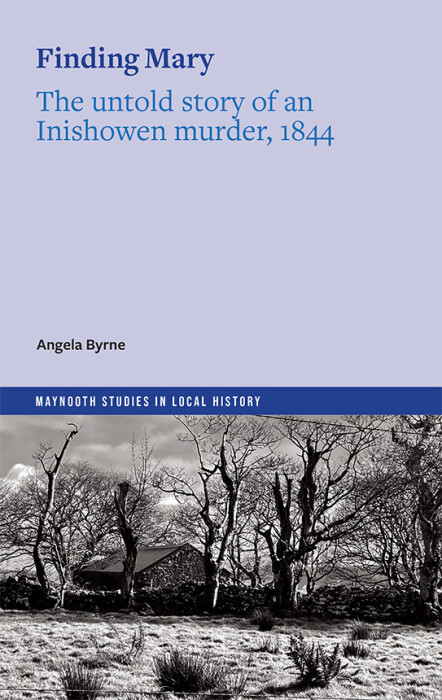
Finding Mary
The untold story of an Inishowen murder, 1844
Angela Byrne
“Based on original research, this book reconstructs the world of a north Donegal village on the eve of the Great Famine to explore the approaches to justice taken by the local community and agents of the Crown (state) and examines the survival of the murder in local folklore to reflect on memory, remembrance and whose stories get to be told. This local history series is highly recommended for genealogists." Ireland’s Genealogical Gazette, November 2025
“Hands up if you sometimes skip the preface of a book. Well please don’t do that when you read Finding Mary. The untold story of an Inishowen murder, 1844. The preface to Finding Mary is a fine piece of literary writing that sets the scene for an enigmatic but true event [...] I wholeheartedly recommend Finding Mary to all students of history.” Berni Dwan, Women's History Association of Ireland, November 2025
“On a Sunday morning in March 1844, Mary Doherty, a 14-year-old servant, was murdered during a robbery at a farmhouse near Culdaff in Co Donegal while the family was out at Mass. The details of her murder were reported nationally and internationally, in lurid detail. The “consternation and disgust” were felt all the more acutely because such an “atrocious and cold-blooded” murder was so rare in rural Donegal, the British weekly paper The Era reported. After a few days, though, the story faded from view and with it all trace of Mary Doherty.
All that remained were the whispers echoing in folk memory about the blood stains that would never wash away from the walls, and the sound of fiddle-playing that could be heard at night if you walked by the site of her murder.
The story of her short life was told, if at all, through the lens of the man who was widely believed to have murdered her, Daniel McKeeny.
Mary vanishes. There are just four references to her in the historical record. It is not known where she was born or where she is buried yet historian Angela Byrne set herself the almost impossible task of ‘Finding Mary’, to quote the title of her book on the untold story an Inishowen murder. At one point the historian, who has proven so adept at retrieving women’s stories from history, felt that she was grasping at air when she attempted to reach across time to trace the scant outline of a woman whose only footprint is the brutal fate she met in death.
The author’s rigorous research creates points on a broad canvas on which the terrible action plays out. She leads the reader expertly through her own discovery of Mary’s murder, outlined rather poetically in the preface, and then she shifts tone to don her historian hat to bring the Donegal of 1844 into sharp focus.
Finding Mary is not really a book about finding all of the answers. It is more a study in how to retrieve a forgotten woman from the cracks of history. While we might not learn much about Mary Doherty, her presence is evident on every single page of this moving book. She was little valued in her short life and less in death, but here at last is a book that shows her short life mattered.” Clodagh Finn, Irish Examiner