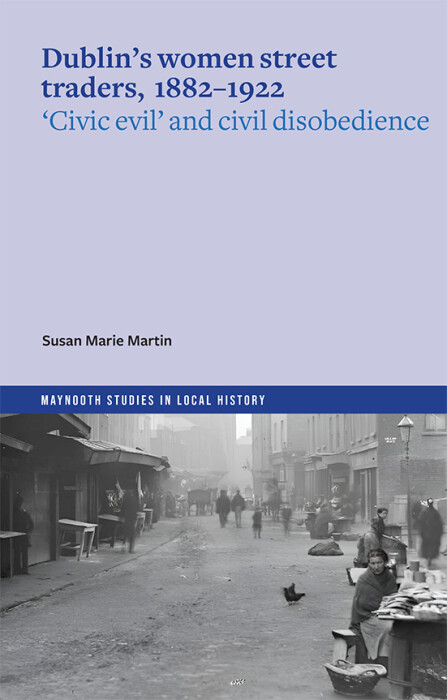
Dublin’s women street traders, 1882-1932
Susan Marie Martin
“Into her pamphlet Ms Martin packs a great deal of social and political history of a kind that is little known, often quite unknown to some I expect.” Peter Costello, The Irish Catholic, 06 November 2025.
“For all the recent uproar about the 'groping' of the Molly Malone statue in Dublin, it is striking how little attention we have paid to the street traders she represents. How ironic, for instance, that the bronze statue by sculptor Jeanne Rynhart was erected in 1988, just a few short years after a heavy-handed crackdown on Dublin’s casual traders. They fought back — with the memorable anthem, Stand by your pram — but with limited success. Susan Marie Martin makes that point in a fascinating new book which charts the resilience and determination of generations of street traders who faced similar struggles as they tried to make an honest living while being moved on, fined, or sometimes jailed in a city that considered them a blight on the cityscape ... The author keeps the focus on the women themselves, winkling out the few traces of their lives and struggles that remain in the historical record ... This is a rigorously researched history book, yet it has something of a cat and-mouse quality to it as Susan Marie Martin skilfully sums up the attempts by the Street Traders Act to corral and regulate traders, and how those affected fought back to protect their livelihood.” Clodagh Finn, Irish Examiner, December 2025
“The book is organised into an introduction, three chapters, and conclusion, interspaced by very interesting figures, which illuminates the text. Martin has consulted a very wide range of sources, resulting in a study that sheds light on a cohort of the population who have been overlooked and forgotten in spite of their essential role in feeding the people, especially those who lived hand to mouth through poverty, unemployment, disability, conditions to which both children and women were particularly vulnerable. The sub-title of the publication: ‘Civil evil’ and civil disobedience could describe any women who defied the prevailing gender norms, including women working in prostitution, and women working for women’s rights, regardless of the social demand for the services and the historical affirmation of the cause. Furthermore, the publication has foregrounded the acts of resistance by the women street traders, a fight that continues, with the decline in capacity in traditional trading areas, especially Moore Street. [...] I enjoyed reading this publication immensely. I grew up in Francis Street, the location of the Iveagh Market and so many street traders, whom we all depended on to provide us with fresh fruit and vegetables. Susan Marie Martin’s research had shone a bright light on the inner city, and especially, on the ways in which women were treated both before independence and afterwards. This is a rich addition to the intersectional analysis that feminist researchers and theorists have compiled over the years, and it is much appreciated.” Brid Connolly, Women's History Association of Ireland, 2026