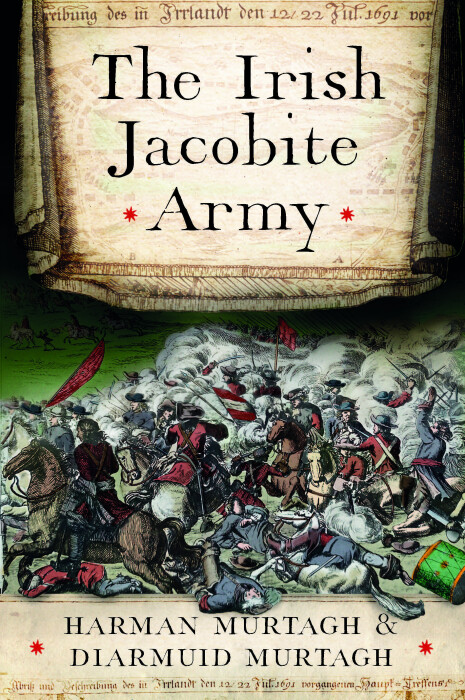
The Irish Jacobite army
Harman Murtagh and Diarmuid Murtagh
"This book is hugely ambitious in its remit, and it has managed to examine its subject in both width and depth, while also supplying the wider context. It serves as a model of how military organizations can be examined in an intelligent and useful way [...] This volume has a wealth of detail on the organisation of the Irish Jacobite army, but embedded within this are higher discussions on the quality and motivation of troops, the personalities of commanders and the conduct of an army on campaign [...] The Murtaghs’ Irish Jacobite army offers us a new and definitive account of a crucially important Irish military formation, and as such it is hugely to be welcomed." David Murphy, History Ireland
“The book’s impressive range covers the peacetime armed forces period of the 1680s, followed by the Battle of the Boyne, when the army supported King James II, the exiled Stuart monarch, against the forces of William of Orange.” Paul Clements, The Irish Times, August 2025
“This is a work that embodies the lifetime’s work of the two most widely-recognised scholars of the Irish Jacobite Army; and, as such, it is a book that fulfils every expectation of being comprehensive. [...] This book is not to be the final word, for there is more to be said about the Jacobite Army, and by Harman Murtagh himself. There is to be a sequel, the publication of which in 2026 is anticipated in the publisher's programme. This will be a book of annotated lists, Regimental lineages and officer lists of the Irish Jacobite army. These lists, eagerly awaited, will complement the narrative in this volume. So, instead of speaking incautiously of final words, let it be confidently predicted that the two volumes, shelved side-by-side, will together rank as the definitive history of the Irish Jacobite Army.” Kenneth Ferguson, The Irish Sword, No. 139 (Summer 2025)
“With this volume, Harman Murtagh and his late father have confirmed their position as the leading historians of the Jacobite army of James II. Diarmuid Murtagh completed a PhD thesis on the Jacobite army in the 1950s and Harman has based this new book on his father’s earlier work, but he has revised and rewritten it utilising newly available sources, reworking his sources, and adding new chapters. The result is a scholarly, lucid, and definitive volume … As befits military historians, there is much on the make-up and battle order of the Jacobite army, with detailed analyses of the infantry (which made up at least 80 per cent of the Jacobite force), cavalry and dragoons, and with full discussions of artillery (lack of gunpowder crippled the Jacobites’ siege warfare), weaponry, finance, logistics and ‘the French dimension’ … A welcome feature of this book is the attention paid to the experience of women in the war: we are told that 1,000 women were in the Jacobite force that besieged Derry and who ‘washed, sewed, nursed, cooked, and even acted as servants’.” Thomas Bartlett, Familia, Number 41, 2025
The Williamite-Jacobite War (1689–91) between the armies of King William III and King James II, or, in Irish, Cogadh an Dá Rí (the War of the Two Kings), still resonates today ... The Irish Jacobite Army provides a more expansive study of this momentous war from the Jacobite perspective, including not only the make-up of military groupings, such as infantry and cavalry, but also the support networks and weaponry used. These micro elements are used by Murtagh to demonstrate that, although it was initially an inexperienced Irish force that struggled in the early phases of the war, by the end of the conflict, it had grown in skill and experience, with French support ... The Irish Jacobite Army is a micro-history that goes beyond previous books on the subject by providing a comprehensive catalogue of the largest Irish army (almost 40,000 men) to have fought in battle prior to the modern period ... A key strength of the book, then, lies in its structure. By having the early chapters about specific battles and sieges, this leaves the later chapters free to reference these events without having to constantly recontextualise them ... The Murtaghs have made a significant contribution to our understanding of the Williamite-Jacobite War, a conflict etched into the collective consciousness of the island of Ireland. Patrick Coleman, Australasian Journal of Irish Studies