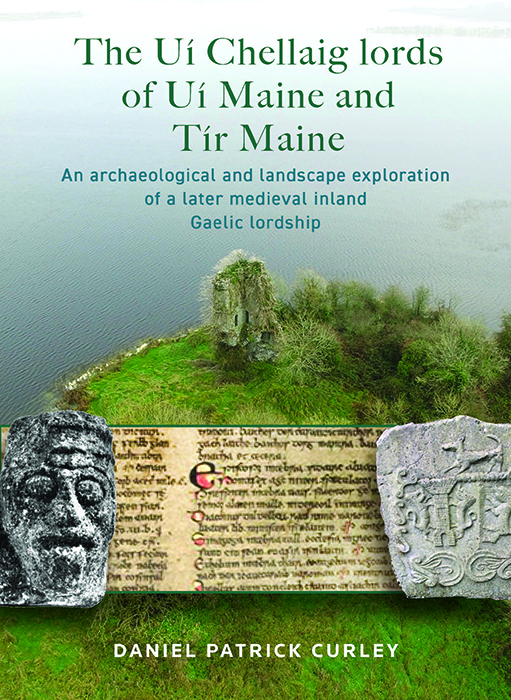
The Uí Chellaig lords of Uí Maine and Tír Maine
An archaeological and landscape exploration of a later medieval inland Gaelic lordship
Daniel Patrick Curley
"The Ui Chellaig lords of Uí Maine and Tír Maine is an archaeological exploration and landscape study of one of the most significant lordships in late medieval Connacht. The Ó Cellaig lords were influential figures within medieval Gaelic society and this book details the settlements, economy and landscape of their inland lordship which covered an extensive part of the midlands. Illustrated throughout with informative maps and photographs, this book offers important insights into the Ó Cellaig lords and their local territories, and indeed into Gaelic medieval Ireland." Archaeology Ireland, Winter 2024
“Back in the 1980s, when the study of settlement and landscape in high and later medieval Ireland began to take off in earnest, little attention was paid to the world of the native Irish. Things have changed: quantitatively, it seems that more has been written over the past quarter-century about the landscape of Gaelic Ireland than about that of colonial Ireland. Dr Curley’s study of the Gaelic lordship of Uí Maine is the latest contribution to the project of redressing a historiographical imbalance. Based on a PhD thesis presented to the University of Galway, this is an outstanding work of scholarship: Daniel has a historian’s command of written sources, a geographer’s acute sense of landscape, and an archaeologist’s comfort with fine-grained survey data. In essence, his book presents a narrative of the changing geography of the lordship between the 12th and 16th centuries, documents its economic basis, and records in exceptional detail and with exceptional clarity the variety of its elite settlement forms ... The book tells a clear story from start to finish ... this is an original and important book.” Tadgh O’Keeffe, Current Archaeology. Issue 422
"This remarkable book ought to be read by anyone with an interest in Irish history ... Curley traces the origins of the Uí Chellaig to the very dawn of Irish history ... Research in Irish history focuses very disproportionately on the English in Ireland, explaining and sometimes even seeming to legitimise English policies and actions in Ireland: Curley’s book helps to redress that prevailing imbalance in Irish historical studies. He highlights the agency exercised by generations of the Uí Chellaig through fluctuating conditions over centuries, identifies their lordly centres (cenn áiteanna) and explores the landscape and economy of the Uí Chellaig lordship. Curley shows in detail how the wealth and power of the Uí Chellaig elite was directly related to agriculture and the exploitation of other natural resources in the area under their authority. Some striking manifestations of that wealth and power can still be seen today. Historians of Gaelic Ireland have long bemoaned the relative lack of documentary evidence — but have often overlooked the abundance of physical evidence of the past dotted around the Irish countryside. Curley’s expert handling of an impressive range of archaeological evidence, much of it gleaned from his own fieldwork, and the clarity of his exposition, and the marvellous array of illustrations presented, make this an outstanding book. He succeeds in conveying clearly the wide range of habitation types used throughout the late medieval period and the striking continuity of habitation at many sites extending over a thousand years. His discussion of the bódhún (cow fort) is especially interesting and important. He also highlights a distinct cultural trend, ‘post c.1400, or perhaps a decade or two earlier’, in the adoption of the tower house castle (264), a form that became ubiquitous across almost all of the country. Curley suggests that intermarriage between lordly families of Gaelic and English descent may have encouraged the growing homogeneity in the style of lordly residences … In his final chapter, Curley expresses his concern that many Irish historians still routinely shy away from the very valuable results and interpretations of their colleagues in other disciplines. Reading this book should cure any cases of silly prejudice or myopia in Ireland’s historical establishment. Gaelic Ireland will never be the same again thanks to Curley’s book. Henry A. Jefferies, Irish Historical Studies (2026)
“The Uí Chellaig lords of Uí Maine and Tír Maine: an archaeological and landscape exploration of a later medieval inland Gaelic lordship identifies and reconstructs the Uí Chellaig lands and settlements from their emergence in the early twelfth century to their demise in the Second Conquest of the seventeenth century.” Daragh Fitzgerald, History Ireland, July/August 2026